It was one of those moments that could only happen in the casual intimacy of friendship.
I was visiting my elder, mentor, and dear friend, Fr. Richard Rohr, in his hermitage in New Mexico. We had already recorded our podcast episode, offered prayers to each other, exchanged an abundance of gifts, and shared our love and appreciation for each other in equal abundance. Then, in the quiet after, still wearing his bathrobes, Richard mentioned an article someone had sent him called Erotic Decisions.[i] He said he loved it so much that he read it aloud as the homily at the recent wedding of one of his closest friends. We looked for it on Substack and there it was—Erotic Decisions by a mysterious author called “Tamara.”
Both the author and the title of her essay were equally mysterious, and so too the name of her Substack account: @museguided. Despite these various layers of mystery, if something is strongly recommended to me by Richard Rohr—as it was—then I was absolutely convinced that I’d love the article. I read it, and loved it, and instantly knew why it had moved him so much.
Each of the words carried that unmistakable tremor of truth: blunt, undeniable, and, of course, challenging. After finishing my reading, I reached out to its author, a woman I had never met. And in our exchange, I realized how, without knowing anything about Gaudiya Vaishnavism, she was saying so much of what we have been carrying for centuries in our sacred tradition—and probably with better wording and depth than many of us could have expressed it.
As an example, let’s dive into the very beginning of the essay—a starting point with a daring claim:
Life doesn’t begin at birth. Nor at conception. Nor at some abstract marker of consciousness or legality. It begins, in earnest, at the moment of trembling recognition. When something stirs beneath reason. When you want something—or someone—without being able to explain why, and you choose to move toward it. That is the erotic decision.
When I read those few initial lines, I was not only shockingly inspired, but I couldn’t help but immediately think of a verse from the ancient Rig Veda I just discovered a few months back:
In the beginning there was desire, the first seed in the mind of the Divine.[ii]
For the ancient Vedic sages existence itself begins not with law, but with longing. Not with certainty but with, in Tamara’s own words, “trembling recognition.” In Sanskrit, this is one of the many names for “grace”: anukampa, or, interestingly enough, “trembling accordingly.” Desire, in this sense, is not lust, not lack, but sacred restlessness: the holy unease that births not only the cosmos, but everything.
Tamara calls these moments “erotic decisions”—when longing refuses to be silenced and cracks open the scripts of security. They are the instances when we lean into aliveness rather than numbness, intimacy rather than control, risk rather than safety. To live erotically, in her vision, is not to indulge whims but to allow ourselves to be undone by what calls us most deeply. It is to trust the tremor.
Like Tamara’s article, Gaudiya Vaishnavism also begins here: not with commandments, but with yearning. Our sacred texts echo the same intuition—that desire itself is divine, that the universe exists because God trembled with ecstatic longing. In our path, eros in its truest sense is not reduced to sexuality, but understood as a metaphysical orientation: the pull toward beauty, intimacy, and becoming.
And fearlessness.
And risk-taking of the highest degree—all for the sake of love.
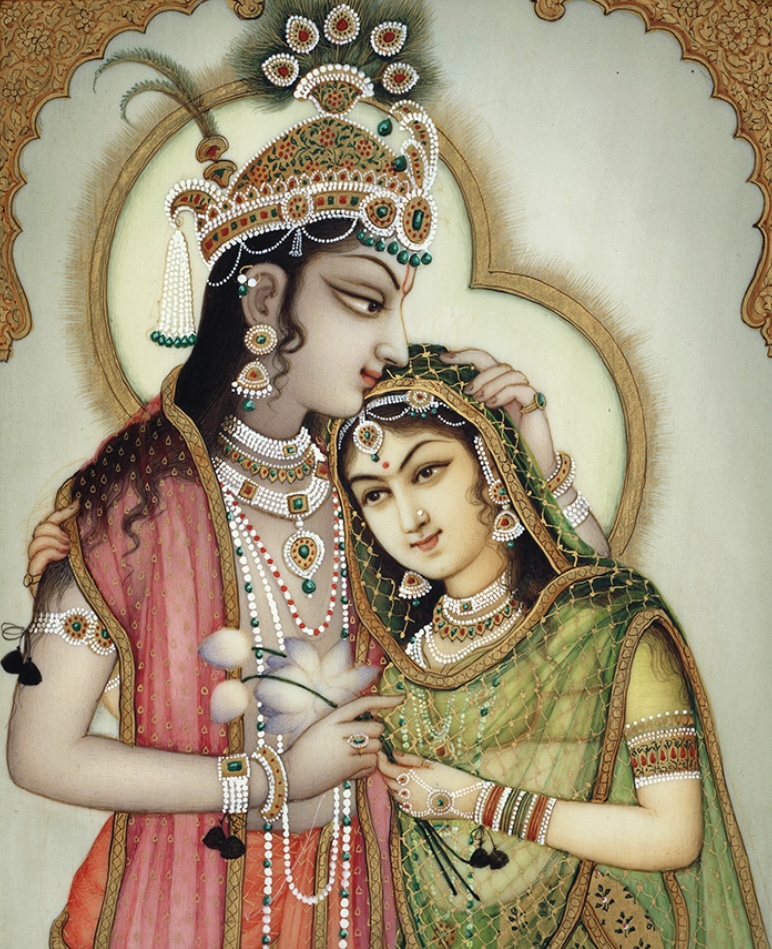
In the Gaudiya tradition, this current of longing takes flesh in the stories of the gopis, the cowherd women of Krishna’s village. They are not saints in the conventional sense. Most of them are married, bound by family and duty, expected to live quiet and secure lives. And yet, when Krishna’s flute sounds in the dead of night, they leave everything—husbands, children, certainty, reputation, even scriptural injunctions—to meet him in the forest. It is not an act of rebellion for rebellion’s sake, but of fidelity to the deepest call of love.
To me, their devotion is the most daring expression of what Tamara names the erotic decision: not a safe attachment, not a manageable affection, but a trembling, transgressive “yes” to the Beloved. In its most unguarded form, Gaudiya Vaishnava teachers call this parakiya-bhava—the sweet and perilous flavor of divine paramour love. But it does not begin with lofty theology. It begins exactly where Tamara places it: in that primal moment when longing stirs beneath reason, and the soul dares to answer.
The author’s words reminded me of what our masters have said again and again: the soul’s deepest longing is not for stability or safety but for a union that undoes us. We spend years arranging our lives into neat patterns—seeking recognition, security, and control—yet love always slips past those borders. It will not be domesticated; it comes as risk, rupture, and a summons to step beyond ourselves. In the case of the gopis, this spirit takes the form of the paramour—the lover who outwardly belongs to another, yet inwardly, and in truth, belongs only to her Beloved.
This is not ordinary infidelity; it is the soul’s highest fidelity to love itself.
By every social measure, the gopis should be utterly satisfied: married, respected, supported, financially stable, enmeshed in the happy duties of village life. And yet, when the sound of Krishna’s flute calls, they forget everything—family, reputation, even the religious codes meant to govern their lives, even themselves—to slip away into the dark forest to satisfy love’s unsatiable thirst for love ever anew.
These gopis act not out of prudence, nor for approval, nor from any trace of self-interest. They act because their hearts know—beyond doubt—that they are being called in the most intimate of ways. Theirs is not a “safe” devotion, but a reckless fidelity to the deepest truth of their being.
After being struck by such impactful content, I couldn’t but write on Tamara’s thread and share some of the above thoughts.[iii] In my very first commentary, I mentioned:
As a monk, I’ve not renounced eros—I’ve simply learned to court it differently. In our path, sexual energy is transmuted, not suppressed—revered as a current of intimacy, creativity, and communion. What you name as erotic decision, we may call madhurya-rasa—the sweetest flavor of divine love, a love that is unruly, ecstatic, and perpetually reaching beyond itself. We are taught that the soul’s highest longing is not for safety, but for loving union that breaks us open and makes us whole.
To my delight, she recognized in this a mirror of what she had tried to capture: eros not as indulgence, nor as repression, but as the wild art of intimacy with what most deeply calls us to life. In that recognition, our two very different vocabularies suddenly resonated in harmony, like two instruments playing the same hidden melody.
And this is what struck me most: we could be two strangers, shaped by entirely different cultural backgrounds and belief systems (in fact, Tamara describes herself in her Substack as a “skeptical empiricist”), and yet end up speaking about divine paramour love in a casual exchange—and basically find ourselves in the same page in terms of its essence. Maybe not with theological precision nor with the technical categories of our respective life paradigms, but in the shared language of longing, passionate desire, and committed intimacy.
And in that, something essential revealed itself to me once again, but yet in a deeper layer: the truths of love are not confined to one lineage, one scripture, or one ritual form. They are somehow written into the core of the human heart, waiting for someone—anyone—to name them.
But there is also a cost.
To live erotically, as she writes, is not to chase pleasure but to “risk undoing.” It is to accept the trembling that breaks the scripts we have been handed, to leave the house of certainty for the wilderness of desire. And this is precisely where her meditation resonates so deeply with the Gaudiya Vaishnava path. For to walk toward the Divine, the ultimate Beloved, is to walk away from everything else that names us, defines us, secures us, or gives us any form of social standing. It is to slip quietly out of the village and into the dangerous forest in a moonless night, not knowing what will happen next—only that love demands it.
The erotic decision is never tidy: it doesn’t come with an exact map or a comforting guarantee, and it rarely looks rational from the outside. But it is precisely here—at the edge of stability, in the trembling space where safety ends—that life, real life, begins to throb.
And there, safety is found anew.
(to be continued)
___________________
ENDNOTES:
[i] You can read the article here: https://museguided.substack.com/p/erotic-decisions.
[ii] Rig Veda 10.129.4.
[iii] The complete thread can be found here:
https://museguided.substack.com/p/erotic-decisions/comment/128161820?utm_source=activity_item.