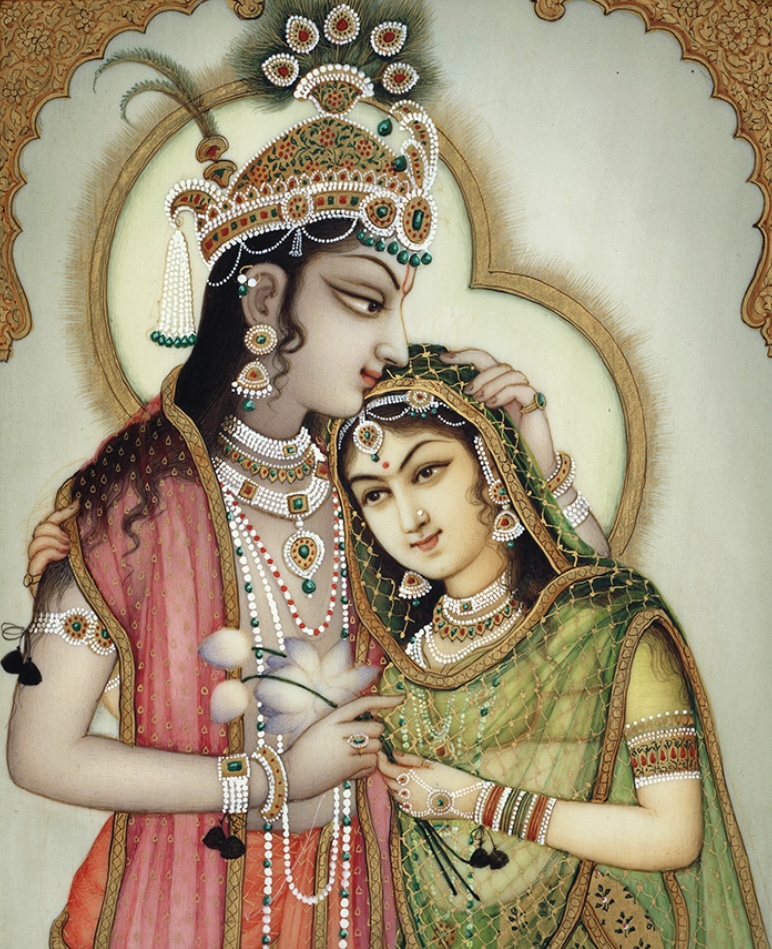
In my previous reflection, I introduced the idea of the erotic decision, a phrase coined by a Substack author named Tamara to describe those trembling moments when longing refuses to be silenced—when we risk safety and predictability in order to move toward what calls us most deeply. For her, life itself begins not with law or certainty, but with longing. For the Gaudiya Vaishnava tradition, this intuition resonates profoundly: our scriptures teach that even the cosmos was born from desire—the divine restlessness of God yearning for relationship.
At the heart of our path lies the conviction that the soul’s highest longing is not for stability or security, but for a love that undoes us. And, according to Gaudiya Vaishnavism, nowhere is this embodied more vividly than in the lives of the gopis, the cowherd women of Krishna’s village. Though bound by family, duty, and reputation, they abandon everything when the sound of Krishna’s flute calls in the night. Their devotion is not a safe attachment but a daring fidelity to love itself—a fidelity so intense that it transgresses every social and religious script for the sake of intimacy with the Beloved.
To name this mystery, our teachers speak of parakiya-bhava—the mood of the paramour, the lover who outwardly belongs to another. It is not a metaphor for moral failure, but for radical fidelity: love so absolute that it risks everything else. In the Gaudiya tradition, this mood reaches its most daring expression in the gopis, whose longing burns without possession, whose devotion transcends every boundary of law, fear, and self-interest. To love as they love is to stand at love’s outer edge, trembling yet unwavering.
But here we must ask the question honestly: what does such love cost? What is the actual price of entering this path of divine paramour devotion?
A friend of mine recently shared with me a quote from Sufi teacher Meher Baba, who once said, “Being is dying by loving.” Few lines capture so well the essence of parakiya-bhava. To step into love at its deepest requires continual death—not once, but again and again: death of ego, death of role, death of the need for control, death of the endless calculations of self-preservation. Yet each of these deaths opens the door to a fuller aliveness, a truer self, a more unguarded pulse. This rhythm of dying and being reborn is the very heartbeat of divine love, and it’s the very definition of any form of true progress.
The Gaudiya texts do not shy away from showing what this looks like in practice. They describe, almost with mischievous delight, the “curriculum” of the gopis, Krishna’s beloved cowherd maidens. Their schooling is not in the arts of safety but in the craft of risk:
[A messenger informs Krishna:] Whispering ear to ear with a friend,
The technique of offering praise of messengers in private,
Dexterity in deception of the husband,
The practice of sneaking out to an arbor at night,
Deafness to the speech of elders,
Keeping the ears pricked at the sound of the flute—
O Krishna,
Today,
With the guru of your adolescence,
Fair young women [i.e., the gopis]
Are studying all these rites.[1]
This is not a sentimental picture of innocence, but a daring syllabus of sacred transgression: transgressing everything to keep in place that which should never be untransgressed—the call to further love. The paramour love of the gopis embody the epithome of this, not learning how to play it safe, but how to risk everything. They master the arts of concealment and courage, learning how to slip away unseen, how to silence the voices of duty and obligation, how to live with their ears forever attuned to the sound of Krishna’s flute. To be a student of love in this sense is to apprentice oneself to fearlessness—endless layers of it, unfolding into eternity.
And here we touch a contrast that is crucial for us as practitioners. The Sanskrit word pratistha is generally translated as a craving for fame and prestige, and is deemed one of the most undesirable elements for one in the pursuit of spiritiuality. Yet, the actual meaning of the word names the craving for stability (stha) at every step (prati), an excessive yearning for certainty, for the kind of secure recognition that prevents change and transformation. It is the impulse to be safely established, surrounded by predictability, measurability, control or, in Gaudiya language, “illusion.”
In contrast to this, the main vow of any true renunciate—whether in the Gaudiya line or in other orders—is abhayatva: fearlessness. Not a timid clinging to structures, but a bold willingness to lose them for the sake of truth. And to trust that truth while jumping into the abyss.
The gopis embody that vow more radically than any monk. Their very lives are a renunciation—not of love, but of the false securities that masquerade as love and, therefore, get in the way of actual love. They do not seek a secure marriage bed, a predictable role, or a socially approved affection. They are not satisfied with the kind of performance—or even devotion—that makes them respectable. They seek the Beloved who hides in the forest, the secret call of the flute that beckons them into the unknown. And they are willing to risk everything for that.
Srila B. R. Sridhara Deva Goswami, one of the greatest teachers of the Gaudiya school, explained this parakiya-bhava with uncompromising clarity. All our obligations to society, family, karma, even scripture—he calls these our pati, our “husband.” They claim ownership over us, demand payment, keep us bound in duty. But the soul, he said, is secretly a lover. And so, like a wife deceiving her possessive husband, we must learn to steal our free will away from those obligations and offer it instead to the Sweet Absolute. At the end of the day, what we are talking about here is not law-abiding religion. It is sacred disobedience. A holy betrayal of every master, teaching, or relationship that in themselves betray the call of love.
Such language may sound shocking. But in truth, it is the very heart of bhakti, or sacred devotion. Krishna himself sanctions it when he says: sarva-dharman parityajya mam ekam sharanam vraja—“Abandon all duties and surrender to me exclusively.”[2] Or when the Sweet Absolute dares to declare: “Those who abandon even the religious systems I have instituted, and serve me alone, are the best of saints.”[3] Bhakti does not ask us to polish our obligations until they gleam. It asks us to steal away from them in the middle of the night, like the gopis, and give ourselves fully to love.
This, then, is the actual price of parakiya-bhava, the sacred divine love of a paramour. It is not paid in ritual performance, nor in theological precision, nor in the currency of public recognition. It is paid in risk and in fearlessness. In dissolving reputation, role, and reason in the fire of longing. It is to be bold enough to say: “Even if scripture, society, and my own habits tell me otherwise, my heart belongs to my Beloved.” This is what one of the main rules of the Gaudiya tradition is:
Always think of the Divine and never forget him. All other rules and regulations exist only to serve these two principles.[4]
No wonder Srila B. R. Sridhara Deva Goswami called this the pati-vanchana, or “the deceiving of the husband.” For in this world, everything claims us—our debts, our history, our inherited scripts, our obligations to duty and reputation. But love claims us more deeply. And so, with stealth, we must carry our free will away from the crowd of creditors and lay it secretly at the feet of our Beloved.
This is not recklessness for its own sake. It is not rebellion for rebellion’s sake. It is radical fidelity. Fidelity not to safety, but to love. Fidelity not to stability, but to the trembling voice that calls us beyond ourselves.
Hegel once said, “Die to live.” And if you want to live, you will have to die—die to the ego, die to the false securities, die to the illusion of control. In the theology of bhakti, this dying is not the end but the beginning. Each death clears space for a new birth, a new aliveness. Each surrender is another chance to be remade. Being is dying by loving.
So what is the actual price of parakiya-bhava? It is everything. It costs every false security we cling to, every identity we polish, every script we follow for safety. It costs our need to be recognized, to be praised, to be in control. It demands deep, committed passion, the kind that risks undoing.
And yet, this love, for all it asks, gives back more than everything in return—an intimacy beyond possession, a freedom beyond fear, and a joy that makes the loss of all else feel like the most sublime gain.
(to be continued)
_________
ENDNOTES
[1] Rupa Goswami, Bhakti-rasamrita-sindhu 2.1.333.
[2] Bhagavad-gita 18.66.
[3] Srimad Bhagavatam 11.11.32.
[4] Krishnadasa Kaviraja Goswami, Chaitanya-charitamrita 2.22.113.